
The Topstep consistency rule caps how much of your total profit can come from a single winning day, so one lucky session cannot carry your whole evaluation. It does not fail your account on its own, it just raises the bar you need to clear or holds up your payout until your trading spreads out more evenly across days. On the Trading Combine, Topstep's own Help Center lists the target at 55%, but Topstep's official X account told a trader in September 2026 the number is 50%, and several third-party prop firm sites repeat that same 50% figure. That gap matters because it changes how close to the edge you can play before a huge day starts working against you instead of for you.
Table of Contents
What the Consistency Target Means on Your Combine
The Combine's Consistency Target measures your single best trading day against your total profit for the evaluation. Topstep's Help Center lists that cap at 55%, while the company's own X account told a trader in September 2026 the real number is 50%. Both sources agree on one thing: a trader can pass in as few as two trading days if their size and profit stay balanced across those sessions.
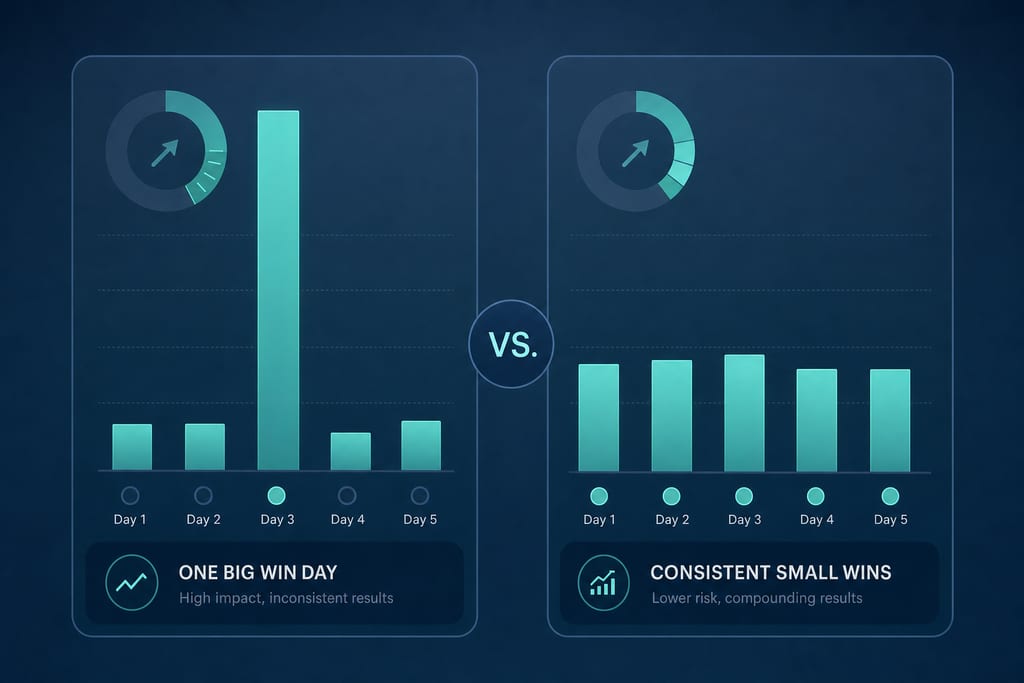
Losses on other days do not reset your best day's dollar amount, and the target applies the same way whether your account balance is near the starting point or well above it. A $3,000 best day against $5,500 total profit sits at 54.5%, which clears the Help Center's 55% but fails the X account's 50%. That is the kind of math a trader needs before assuming they are in the clear.
- Help Center figure: 55% cap on best day vs total profit
- X account figure: 50% cap, confirmed passable in two days
- Losses: do not reset or lower your best day
- Balance size: rule applies the same at any account balance
- Action: plan toward the 50% figure since it is the stricter of the two
Since Topstep's own Help Center and its X account disagree, the safer move is to trade as if the lower number is the real one and treat 55% as a cushion, not a target.
How the Consistency Objective Works on Funded Payouts
Once you're funded through an Express Funded Account, the Consistency Objective is a separate, optional payout path with its own math. The formula is largest single-day net profit divided by total net profit, and that result has to land at 40% or below to qualify. Topstep's blog says you also need at least three trading days on this path before you're payout eligible, which then unlocks 50% of your account balance up to $6,000.
Here's a video that digs into whether these rules work for or against traders.
The Standard path skips the percentage math entirely, but it asks for five winning days of $150 or more before your first payout request. Picking one path over the other depends on whether your trading naturally spreads across many small wins or leans on fewer, bigger days.
- Consistency path: 40% cap, three trading days minimum, up to $6,000 per request
- Standard path: no percentage rule, five winning days of $150+ required
- After a payout request on the Consistency path, the ratio resets to $0
- Only new profit counts toward the next payout calculation going forward
- Straight Funded Accounts, per Topstep's X reply, carry no consistency rule at all
Checking Your Own Numbers Before You Trade Again
Run your own consistency ratio before you assume you're clear, because the math is simple but easy to get wrong by hand. Say you had five profitable days and one of them made up 60% of your total profit. That fails both the 55% Help Center target and the stricter 50% figure from Topstep's X account, no matter which one applies to your account.
Spreading your size more evenly across sessions, or trimming the size on one outsized winning day, brings that ratio back under the line without changing your total profit much at all. A trader who cuts that 60% day down to 45% of total profit by adding two more moderate days clears both thresholds with room to spare.
- Pull total net profit for the evaluation or payout window
- Identify your single largest profit day in dollars
- Divide that day's profit by total profit to get your ratio
- Compare the result against 50%, 55%, or 40% depending on the stage
- Trim size on oversized days or add more trading days if the ratio is too high
Pulling a broker CSV and doing this by hand across dozens of trading days is slow, and one typo in a spreadsheet throws the whole ratio off. MyTraderScore's dashboard breaks out P&L by day straight from a CSV export, so a lopsided day shows up at a glance instead of after a manual recalculation.
Check Your Split Before You Request That Payout
Before you click submit on a Combine pass or a payout request, open your last ten trading days and look for one that dwarfs the rest in dollars. That single day is the number that decides whether you clear the bar or get pushed into a higher profit target and a longer wait. Catching it now costs a few minutes of reading your CSV. Catching it after a rejected payout costs days, or forces you to trade a bigger target from scratch. MyTraderScore pulls that per-day breakdown straight from your export, so you see the real split instead of guessing which session carried your account.
Stop losing trades and start making more money.
Start freeQuestions Traders Ask About the Consistency Rule
Does an open trade on my biggest day count toward the consistency ratio?
No, Topstep's consistency math runs on net profit for days that have already closed out, not on open positions marked to market. A trade still running at the end of the day does not add to or shrink your best day's total until it is closed. If you are checking your ratio mid-session, work from your closed P&L only, since unrealized gains or losses can swing before the day ends.
Will trading a second funded account change my consistency ratio?
No, each account's consistency ratio is calculated on its own, using only the profit and trading days inside that account. A big day on one account does not add to or offset the ratio on a separate account, even if you run both at the same time. Treat every account as its own evaluation or payout window when you check the math.
What happens if I fail the consistency target instead of the profit target?
You do not fail the Combine outright, your required profit target goes up instead, so you need more total profit before you can pass. On the Express Funded Account Consistency path, missing the 40% mark simply delays payout eligibility rather than closing the account. Either way, the fix is the same: add more trading days or trim the size of your biggest winner so the ratio drops below the threshold for your stage.