
Risk reward ratio is the math that compares what you stand to lose on a trade against what you stand to make, and it decides whether your strategy survives long after your win rate stops mattering. A trader who wins only 35 percent of the time can still grow an account if every winner pays out three times what every loser costs. Flip that math around, chase small wins while letting losers run, and a 70 percent win rate can still bleed an account dry over a hundred trades. The specific numbers you pick, the way you set stops and targets on futures, crypto, or stock trades, and the way prop firm drawdown rules shape those choices all change the outcome, which is why real examples matter more than the general idea.
Table of Contents
How to Calculate Your Risk Reward Ratio
Risk reward math compares the distance from your entry to your stop against the distance from your entry to your target. Divide the reward distance by the risk distance and that number is your ratio, whether you trade in points, ticks, or dollars.
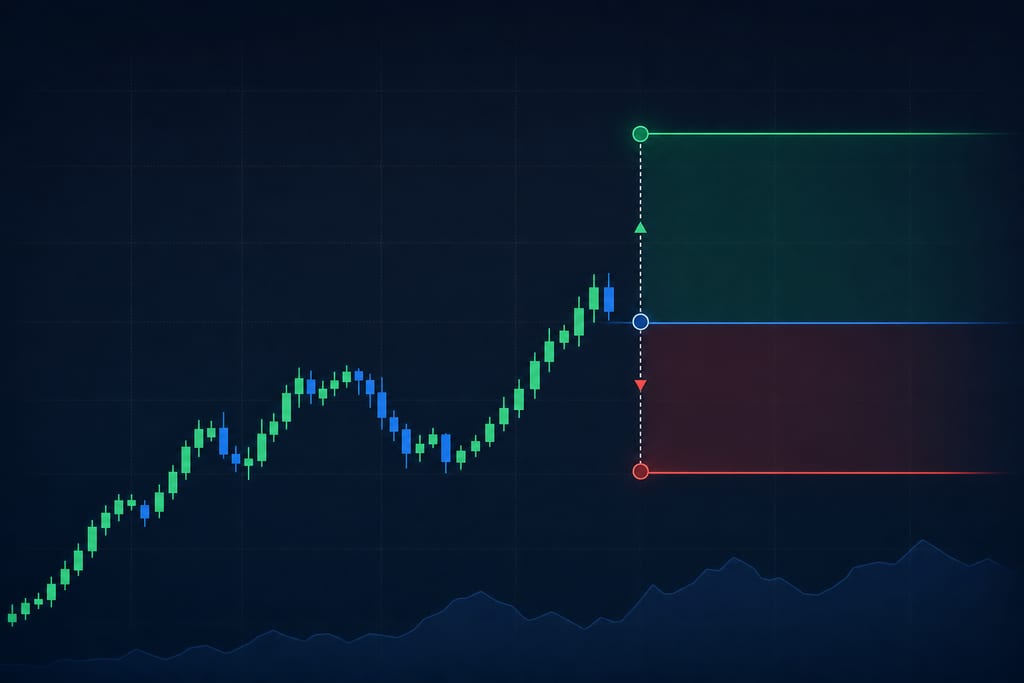
On an ES futures contract, say you enter at 5800, set your stop at 5796 (4 points, $200 at $50 per point), and your target at 5812 (12 points, $600). That's a 1:3 ratio before the trade even fills. A crypto swing trader buying BTC at 62,000 with a stop at 60,500 and a target at 67,000 is risking 1,500 to make 5,000, close to the same 1:3 setup on a totally different asset.
| Instrument | Risk | Reward | Ratio |
|---|---|---|---|
| ES futures | $200 (4 pts) | $600 (12 pts) | 1:3 |
| BTC swing | 1,500 | 5,000 | 1:3.3 |
| AAPL day trade | $150 | $300 | 1:2 |
The entry, stop, and target have to be set before you click buy, not after. Once you're in the trade, fear and hope start negotiating with your plan, and that's how a clean 1:3 setup turns into a coin flip.
What Ratio Actually Works for Your Win Rate
Your ratio and your win rate are a pair, and one without the other tells you nothing about whether a strategy makes money. A 1:1 ratio needs over 50 percent win rate just to clear fees and commissions, since every loss costs the same as every win. A 1:3 ratio can stay profitable with a win rate under 30 percent, because the few winners carry three times the weight of each loss.
- 1:1 ratio needs roughly 51 percent or higher win rate to break even after costs
- 1:2 ratio needs roughly 34 percent win rate to break even
- 1:3 ratio needs roughly 26 percent win rate to break even
- 1:4 ratio needs roughly 21 percent win rate to break even
Prop firm challenge traders can't just chase the highest ratio on paper. A 1:4 target sounds great until a daily loss limit of $1,000 means you can only take two losing trades before you're locked out, so the ratio has to fit inside that drawdown rule, not just the math.
Common Mistakes That Wreck Good Ratios
A well-planned ratio gets destroyed by habits formed in the middle of a trade, not by bad math. Moving a stop loss further away out of fear turns a clean 1:3 setup into something closer to 1:1 or worse, because the risk side just grew while the reward side stayed put.
Closing winners early while letting losers run does the same damage from the other direction, it flips your planned ratio upside down trade by trade until the strategy that looked profitable on paper is losing money in real execution.
Most traders never check their executed ratio against the one they planned, which means they repeat the same mistake for months without knowing it. MyTraderScore pulls that comparison straight from your broker CSV so you can see your actual average ratio next to your planned one.
- Set the stop and target before entry, then leave them alone
- Take the planned target even if the trade feels like it has more room
- Cut the loss at the planned stop, never past it
- Review executed ratio against planned ratio at the end of each week
Set Your Minimum Ratio Before Your Next Trade
Write down your minimum ratio tonight, before your next session starts, not after a loser has you second-guessing. Pick a number from the table above that matches your win rate, then hold it for the next 20 trades without changing it mid-stream. Pull your last month of fills and check your actual average ratio against that number instead of trusting your memory, since most traders misjudge their own execution by a wide margin. MyTraderScore reads your broker CSV and lines up your real ratio and win rate next to your plan, so you know in minutes if the strategy is working or just feels like it is.
Stop losing trades and start making more money.
Start freeRisk Reward Ratio Questions Traders Ask
Does risk reward ratio change for scalping versus swing trading?
The ratio math stays the same, but the distances get smaller for scalping and bigger for swing trading. A scalper might risk 2 ticks to make 6 ticks, still a 1:3 setup, while a swing trader risks 50 cents to make $1.50 on the same ratio. What changes is how many trades you need to see that edge play out, since scalpers get more reps per day.
What happens to my ratio if a trade gets partially filled or slipped?
Slippage and partial fills shrink your real ratio below what you planned, even if your stop and target levels never moved. A 1:3 setup can turn into 1:2.5 if your entry fills two ticks worse than expected, or your stop fills a point past the level in a fast market. Thin, low-volume symbols and news-driven moves cause this most, so check your fill price against your planned entry on every trade.
Can a high risk reward ratio still lose money if my stops are too tight?
Yes, a tight stop can get hit by normal price noise before the trade ever has a chance to reach its target. A 1:5 ratio looks great on paper, but if the stop sits inside the symbol's normal wiggle room, you get stopped out on most attempts regardless of your win rate math. The stop needs room to survive the instrument's normal movement, not just a number that makes the ratio look good.